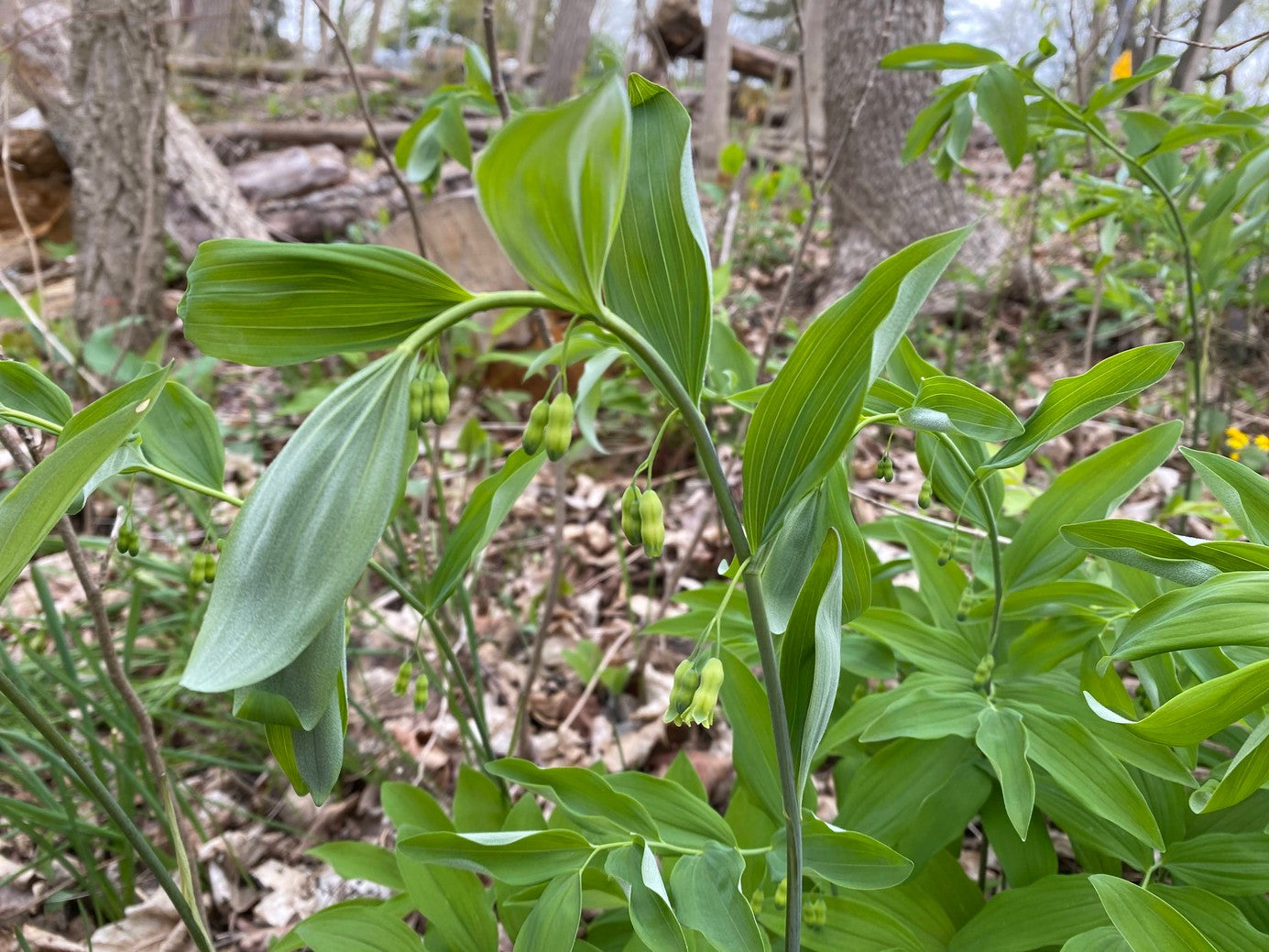
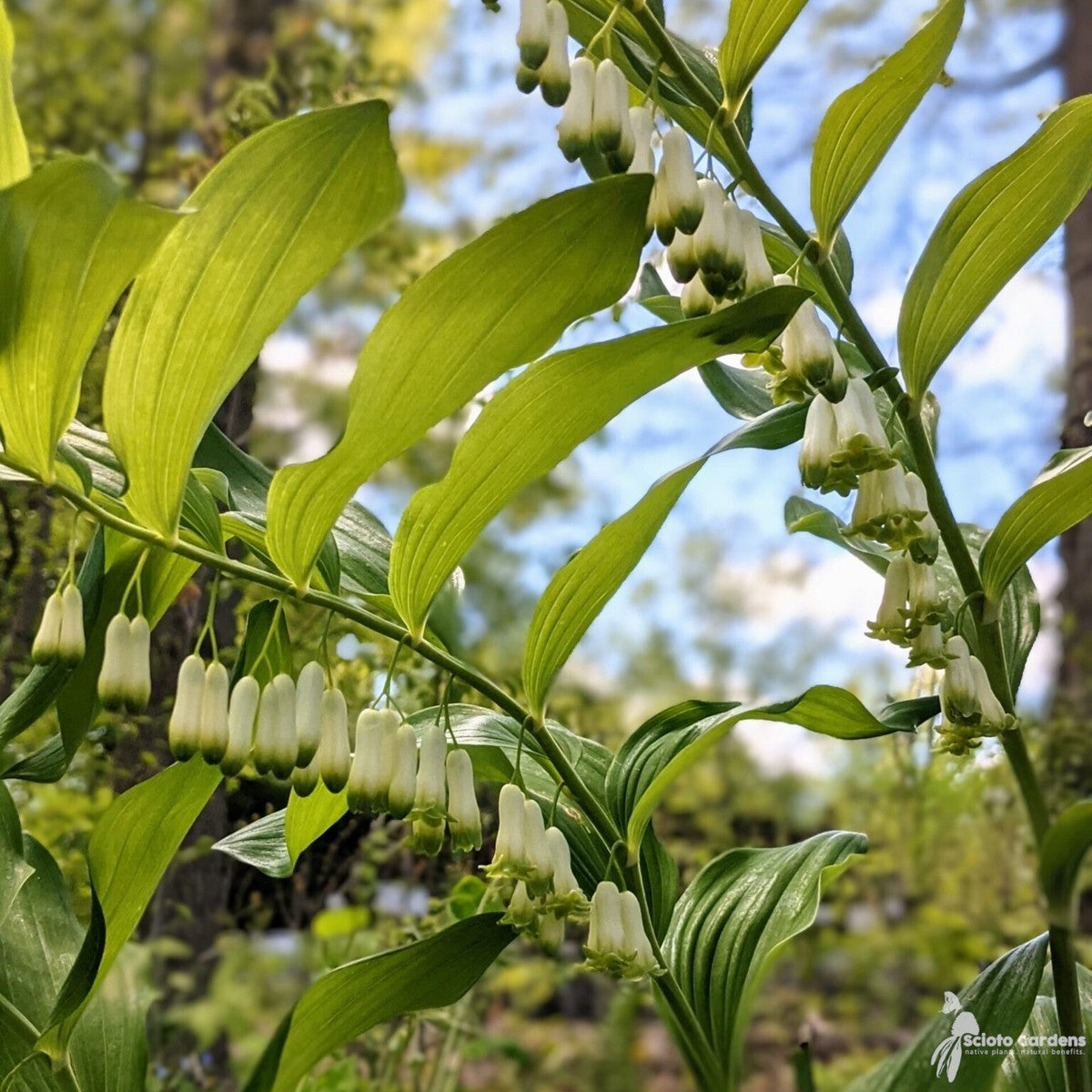
Solomon's Seal is an elegantly arching, graceful, native woodland wildflower. It has a clump-forming growth habit with slowly spreading rhizomes. Its medium green, oval shaped leaves zig-zag down long, unbranched stems which are upright and arching. It makes a stunning vertical accent in the shade garden! It pairs well with ferns, coralbells, hostas, foamflowers, and other classic woodland garden plants. The foliage becomes an attractive, delicate yellow in the autumn before fading away.In May and June, pendulous whiteish-green, bell-shaped flowers hang from the underside of the stems, usually in pairs, and attract a plethora of pollinators, mostly bees and occasionally even Ruby-throated Hummingbirds! The flowers offer both nectar and pollen. Greenish berries will follow the pollinated flowers, maturing to a beautiful blue-violet color. These berries are attractive to many woodland bird species. Unfortunately, White-tailed Deer are quite fond of Solomon's Seal and will often munch it down to the ground when they find it, so some protection may be warranted when planting it.Sources:
Growing and Propagating Wildflowers by William Cullina
The Midwestern Native Garden by Charlotte Adelman & Bernard L. Schwartz
Eastern/Central Medicinal Plants and Herbs by Steven Foster and James A. Duke
Peterson Field Guide to Edible Wild Plants Eastern/Central North America by Lee Allen Peterson
Missouri Botanical Garden
Lady Bird Johnson Wildflower Center
Illinois Wildflowers
The Morton Arboretum-Black Walnut Tolerance


Limited Time Offer:
0
days
0
hours
0
mins
0
secs
Polygonatum biflorum (Solomon's Seal) - 2 gal
Solomon's Seal

Plant Care & Installation Quick-Guide
Proper acclimation and installation are key to your plant's success. Please cross-reference these tips with your plant's specific ID tags:
·
Pre-Planting: Store plants in a light-appropriate area on soil or grass (avoid hot concrete or asphalt) and water daily until the soil is saturated and the pot feels heavy. If temperatures drop below 30°F, move pots to a garage or cover them to prevent root freeze.
·
Installation: Dig a hole matching the depth of the pot, remove the fabric container, and ensure the plant’s crown or root flare is level with the ground. Fill gaps with soil, water heavily, and apply 2 inches of mulch—keeping it clear of the stem.
·
Ongoing Care: Check moisture daily by feeling 1–2 inches into the soil; water deeply at the base if the soil feels dry or warm. Newly installed plants require frequent watering (up to 3–4 times weekly in heat) until fully established, which can take a few months for perennials and up to two years for trees.