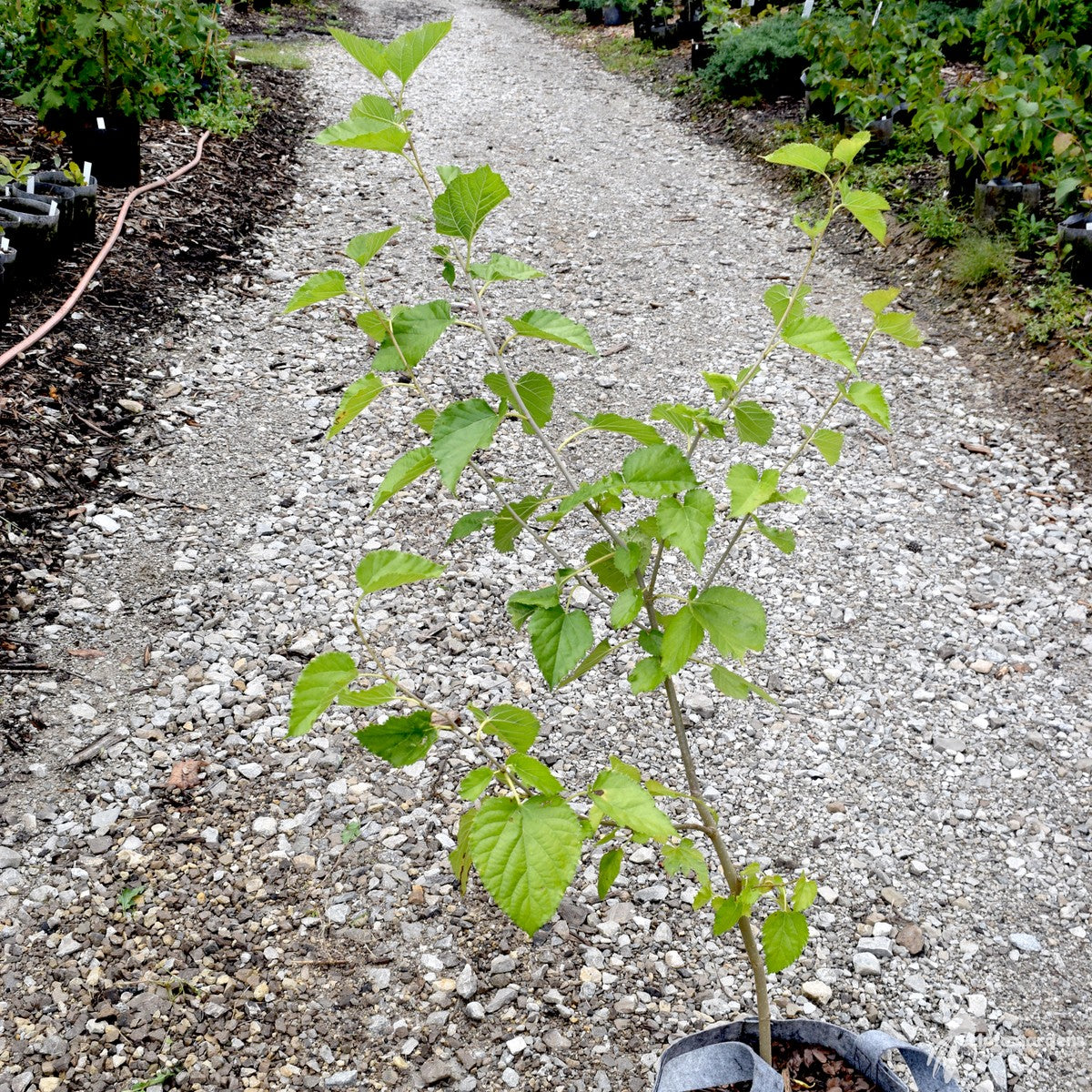
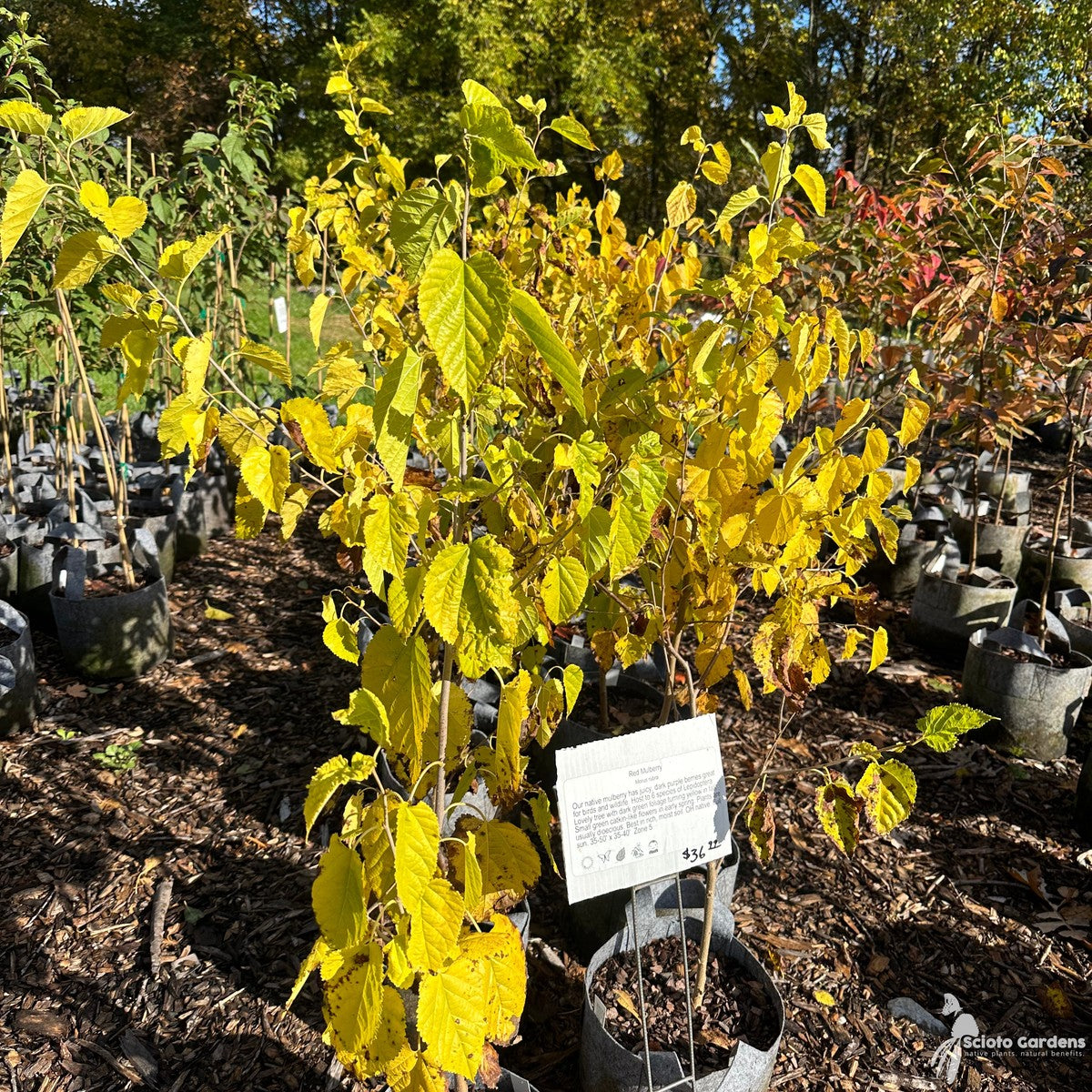
Red Mulberry is a native, medium-sized understory tree that produces long, juicy, dark purple fruits. The trees are fast-growing and can reach heights of 50', and rarely, even taller. They are typically dioecious, having male and female flowers on different plants, but occasionally one will turn out to be monoecious (having both sexes on the same plant.) For best fruiting, a male and a female tree are necessary. The flowers (catkins) are wind-pollinated May to June and followed by the elongated, blackberry-like fruits which start out green and mature to dark purplish-black by mid-summer.
The fruits are quickly devoured by all manner of birds and mammals. They are delicious to eat straight off the tree, and not available in stores due to their inability to be transported and stored. Fruits can also be made into wine, jam, jelly, pies, and cakes. It can take Red Mulberry 10 years from seed to fruit-bearing age.
Fruiting Red Mulberries are not recommended for small, urban gardens due to the staining power of the fruit debris. They can stain pavement, cars, shoes and wherever those shoes go. It is best planted in full to partial sun areas with rich soil and ample space around the tree to allow it to drop fruit and not appear messy. It is a great tree for wildlife and a beautiful specimen in summer full of fruit, and in fall when it turns bright yellow.
Non-native, invasive White Mulberry (Morus alba) is widespread and aggressively colonizes open, sunny areas. Here is an article that explains the many ways to distinguish between them.
Sources:
Manual of Woody Landscape Plants by Michael A. Dirr
Gardening for the Birds by George Adams
Missouri Botanical Garden
Lady Bird Johnson Wildflower Center
Illinois Wildflowers


Limited Time Offer:
0
days
0
hours
0
mins
0
secs
Morus rubra (Red Mulberry) - 3 gal
Red Mulberry

Plant Care & Installation Quick-Guide
Proper acclimation and installation are key to your plant's success. Please cross-reference these tips with your plant's specific ID tags:
·
Pre-Planting: Store plants in a light-appropriate area on soil or grass (avoid hot concrete or asphalt) and water daily until the soil is saturated and the pot feels heavy. If temperatures drop below 30°F, move pots to a garage or cover them to prevent root freeze.
·
Installation: Dig a hole matching the depth of the pot, remove the fabric container, and ensure the plant’s crown or root flare is level with the ground. Fill gaps with soil, water heavily, and apply 2 inches of mulch—keeping it clear of the stem.
·
Ongoing Care: Check moisture daily by feeling 1–2 inches into the soil; water deeply at the base if the soil feels dry or warm. Newly installed plants require frequent watering (up to 3–4 times weekly in heat) until fully established, which can take a few months for perennials and up to two years for trees.